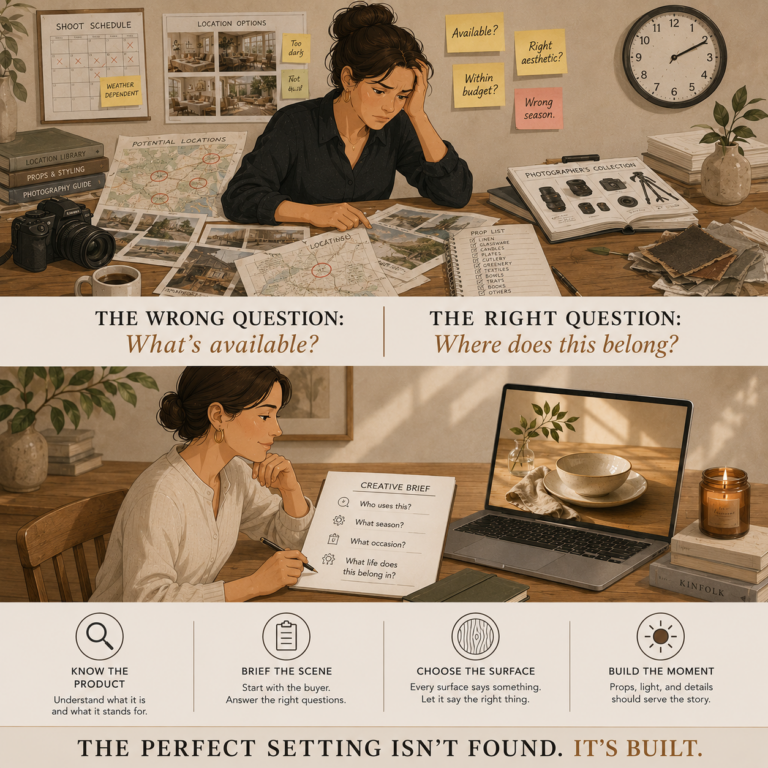

Why Your Product Needs to Live Somewhere — And How That Scene Sells It Twice

Why Your Product Needs to Live Somewhere — And How That Scene Sells It Twice
A product image answers one question: What is it?
A location image answers the question that actually drives the sale: Where does it belong in my life?
That difference is everything.
Where a Product Lives Is Part of What It Is
When a buyer evaluates a tableware line, they’re not just looking at the piece.
They’re asking:
- Does this fit the aesthetic of my store?
- Will my customer be able to picture this on their table?
- Does this feel like it belongs in a real home — or does it feel like a catalog?
A white background can’t answer any of those questions.
A location scene answers all of them before the buyer has to ask.
The setting communicates mood, scale, occasion, and lifestyle in a single image. It does the work that a product description never can.
The Traditional Location Shoot Problem
The brands that understand this invest in location photography.
And they pay for it.
A single location shoot — venue rental, stylist, photographer, props, travel, post-production — runs $3,000 to $8,000 for one day.
That one day might yield:
- One setting
- One season
- One mood
- 8 to 12 usable images if everything goes perfectly
Then the season changes. The trend shifts. A new collection launches. A retailer needs a holiday scene in July for their buying calendar.
And you’re back to zero.
The cost isn’t just the shoot. It’s the limitation.
No budget solves the fundamental problem: your product belongs in dozens of different scenes, and you can only afford to shoot one.
Seasonality Is a Sales Calendar Problem
Retail buyers don’t buy for today. They buy 4 to 6 months ahead.
That means:
- Holiday imagery needs to exist in summer
- Spring collections are evaluated in fall
- A buyer looking at your line in October needs to see it on a Christmas table — not a harvest scene from last year’s shoot
If your imagery is locked to the season you shot it, you’re always behind the buying calendar.
The brands winning at wholesale have imagery ready when the buyer is ready — not when the weather cooperates.
A flexible image system delivers a Christmas morning table in July. A spring brunch setup in November. An outdoor summer scene in February.
Your imagery works on the buyer’s timeline, not yours.
Two Different Buyers. One Solution.
Here’s where location imagery earns its place twice.
Buyer One: The Retailer
The wholesale buyer evaluating your line is thinking about their store.
They’re asking:
- How does this look in a display vignette?
- Can I build a table setting around this for my floor?
- Does this photograph well for my website and social?
They need to see your product in a setting that maps to their retail environment — a styled scene that shows them exactly how to merchandise it.
When your image does that work, the buyer doesn’t have to imagine it. They just have to order it.
Buyer Two: The Retailer’s Customer
The end consumer standing in that store — or browsing that retailer’s website — is asking a different question entirely.
They’re asking:
- Does this belong in my home?
- Can I see this on my table, in my kitchen, at my next dinner party?
- Does this feel like me?
They’re not buying a product. They’re buying a version of their life that includes your product.
A location image that places your piece in a real, recognizable setting — a Sunday morning kitchen, an outdoor summer table, a holiday dinner — answers that question instantly.
Two different problems. One well-built scene solves both.
The retailer sees how to sell it. Their customer sees how to live with it.
The Scenes That Drive Sales
Not all location imagery is equal.
The scenes that consistently move product share a few qualities:
- Specific but not exclusive — a setting that feels real without feeling like someone else’s home
- Occasion-aware — morning, evening, casual, celebratory — the occasion frames the need
- Seasonally relevant — not just decorated for a holiday, but genuinely of that moment
- Editorially restrained — the product is the focus; the setting supports it without competing
The brands that get this right — Crate & Barrel, Pottery Barn, Williams Sonoma — don’t shoot everything. They shoot the right scenes deliberately.
That’s the standard your imagery needs to meet to compete for the same retail accounts.
The Simplest Way to Say It
Your product doesn’t exist in a vacuum. It exists in homes, on tables, in stores, in seasons, in moments.
The image that shows that — clearly, consistently, and on the buyer’s timeline — is the image that sells.
Everything else is just showing what you have.
Go483 builds location-based lifestyle image systems for wholesale home and tableware brands — any setting, any season, any time of year. Learn how it works.