How Much Should You Budget for Product Photography?
How Much Should You Budget for Product Photography? A Real-Number Guide for New and Growing Lines
Most brands figure out their photography budget the wrong way.
They price out a shoot, react to the number, cut corners, and launch with imagery that quietly costs them sales for years.
This is the honest breakdown nobody gives you upfront — what things actually cost, what’s worth spending on, what you can do yourself, and how to think about photography as a sales investment rather than a line item to minimize.
The Two Types of Images Every Product Line Needs
Before budgeting anything, understand that product photography is not one thing. It’s two — and they serve completely different purposes.
White Background Images
Clean. Isolated. Product only.
These live on:
- Faire and wholesale platform listings
- Line sheets and catalogs
- Amazon and DTC product pages
- Press kits and media requests
They answer one question: What is it?
They do not sell desire. They document the product. And for many wholesale contexts, that’s exactly what’s needed.
Lifestyle Images
Product in context. A real setting, real light, real scene.
These live on:
- Wholesale pitch decks and retailer outreach
- Your website hero and collection pages
- Social media and editorial placements
- The moment a buyer decides your line belongs in their store
They answer the question that actually drives the sale: Where does this belong — and do I want it there?
You need both. But they have very different budgets — and very different rules.
White Background: The DIY Case
This is where we give you permission to spend less.
A professional product photographer charges:
- Budget/freelance: $25–$75 per image
- Mid-tier commercial: $75–$150 per image
- High-end commercial: $150–$400+ per image
Most photographers work on a day or half-day rate and deliver a set number of images. A photographer charging $800 for a half-day might deliver 20 images — $40 each — or 8 images — $100 each. The per-image math depends entirely on how efficiently the shoot runs.
For a new tableware line with 12 to 20 SKUs, a mid-tier white background shoot runs $1,200 to $3,000 depending on your market and complexity.
The DIY alternative is genuinely viable here.
A collapsible lightbox, two LED panels, a white sweep, and a modern smartphone camera — available on Amazon for $100 to $200 total — will produce clean, consistent white background images that are good enough for Faire listings, line sheets, and most wholesale contexts.
Thousands of successful wholesale brands do exactly this.
When DIY is good enough:
- Faire and independent wholesale platform listings
- Internal line sheets and sales materials
- Early-stage launches where budget is limited
When you need a professional:
- Major retailer submissions with specific technical requirements
- DTC hero shots where image quality directly affects conversion
- Press and editorial placements where production quality is evaluated
The honest advice: start with DIY white background. Invest the savings in lifestyle imagery. That’s where the sale actually happens.
Lifestyle Photography: Why This Is Different
You cannot DIY a lifestyle shoot the way you can DIY a white background shot.
The skill gap is real — location scouting, lighting setup, art direction, styling, composition, and post-production are not smartphone skills. And the logistics gap is just as significant.
What a traditional lifestyle shoot actually costs:
A professional lifestyle shoot — venue or location rental, photographer, stylist, props, travel, post-production — runs $3,000 to $8,000 for a single day.
That single day delivers:
- One setting
- One season
- One mood
- 8 to 12 usable images if everything goes well
Then the season changes. A new collection launches. A buyer needs a holiday scene in July for their purchasing calendar.
And you start over.
The cost isn’t just the shoot. It’s the limitation.
No budget solves the fundamental problem: your product belongs in dozens of different scenes, and a single shoot captures one.
Building a Real Budget: New Line vs. Growing Line
Launching a new line on Faire:
Minimum viable budget:
- White background: $0–$500 (DIY or entry-level freelancer)
- Lifestyle imagery: $750–$1,500 for a focused set of hero scenes
- Total: $750–$2,000
This gets you functional wholesale listings and enough lifestyle content to make a credible first impression.
Existing line trying to break into wholesale accounts:
To compete for independent boutiques, kitchen stores, and gift shops:
- White background: already done or DIY refresh — $0–$300
- Lifestyle imagery: $1,500–$3,500 for seasonal scenes across your core patterns
- Total: $1,500–$3,800
Existing line targeting major retailers (Wayfair, Perigold, Anthropologie, McGee & Co):
This tier requires imagery that competes with brands spending significantly more. One weak image can end a conversation with a buyer before it starts.
- White background: professional quality required — $500–$1,500
- Lifestyle imagery: $3,000–$8,000+ for a full location shoot
- Total: $3,500–$9,500 minimum — and that’s before the next season
The Number That Changes the Conversation: Lifetime Value
Photography budgets feel large until you put them next to what a single wholesale account is actually worth.
One independent boutique account:
- Initial order: $1,500
- Two reorders annually over 5 years: $8,000–$10,000
- Lifetime value: $9,500–$11,500
One mid-tier specialty retailer:
- Initial order: $3,000–$5,000
- Seasonal reorders over 5 years: $12,000–$20,000
- Lifetime value: $15,000–$25,000
One major retailer account (Wayfair, Perigold, Anthropologie, McGee & Co):
- First year volume if the line performs: $20,000–$50,000+
- Lifetime value if you maintain placement: the kind of number that changes a brand’s trajectory
Now look at the photography budget differently.
A $750 lifestyle image suite that wins you one boutique account pays for itself on the first order.
A lifestyle image suite that gets your line in front of a Perigold buyer pays for itself the first time they reorder.
The question isn’t what photography costs.
The question is what it costs you not to have the right imagery when the buyer is looking.
What the Best Brands Understand
Major retailers don’t treat photography as a cost to minimize.
They treat it as a sales tool — one that works every hour of every day, in every market, for every buyer who encounters their line.
The brands competing for the same retail accounts need imagery that meets the same standard.
Not because it’s nice to have. Because buyers make decisions from screens, and the image is the product until the product arrives.
Brands that underspend on lifestyle imagery and overspend on white background shots have their priorities exactly backwards.
White background documents. Lifestyle sells.
Two Choices. One Decision.
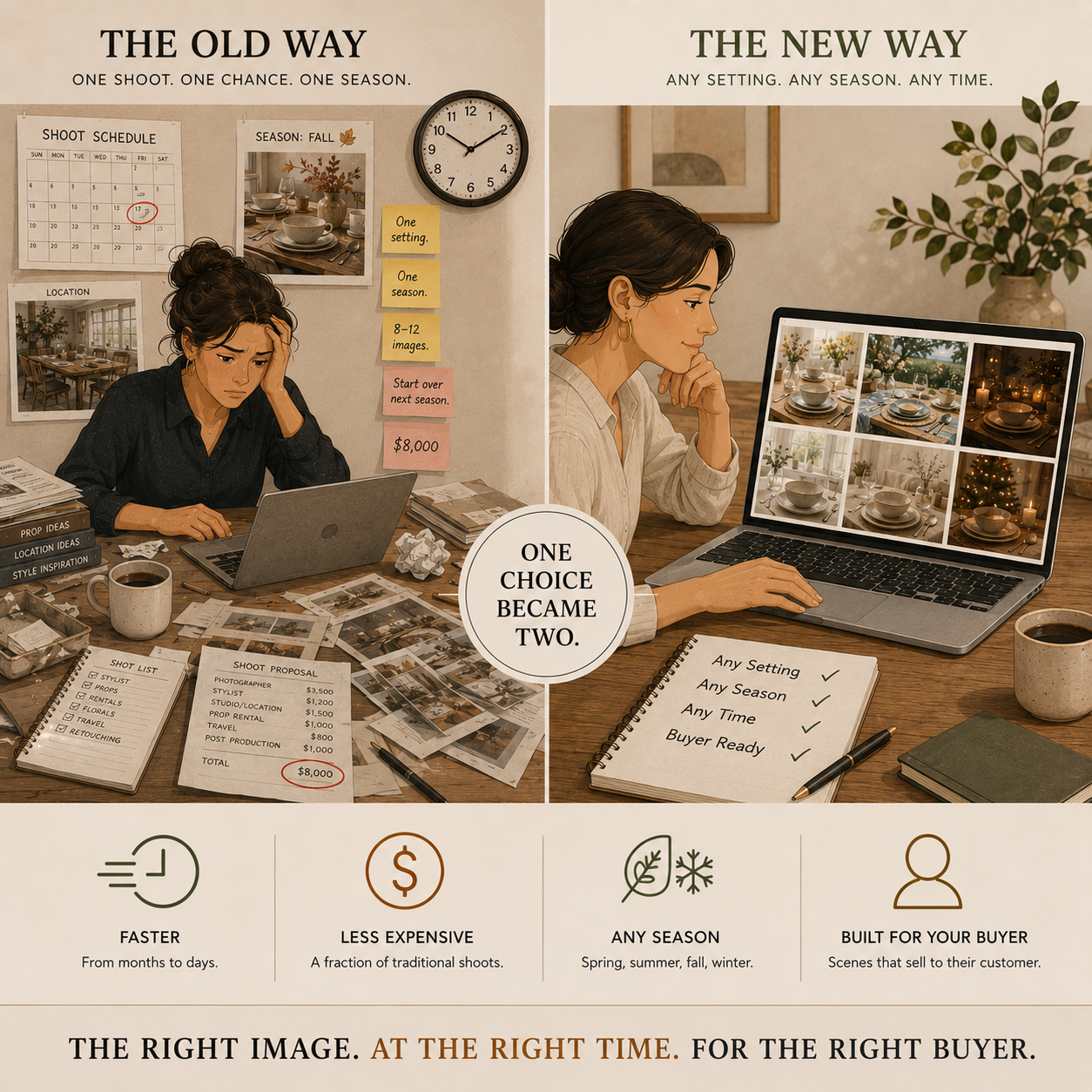
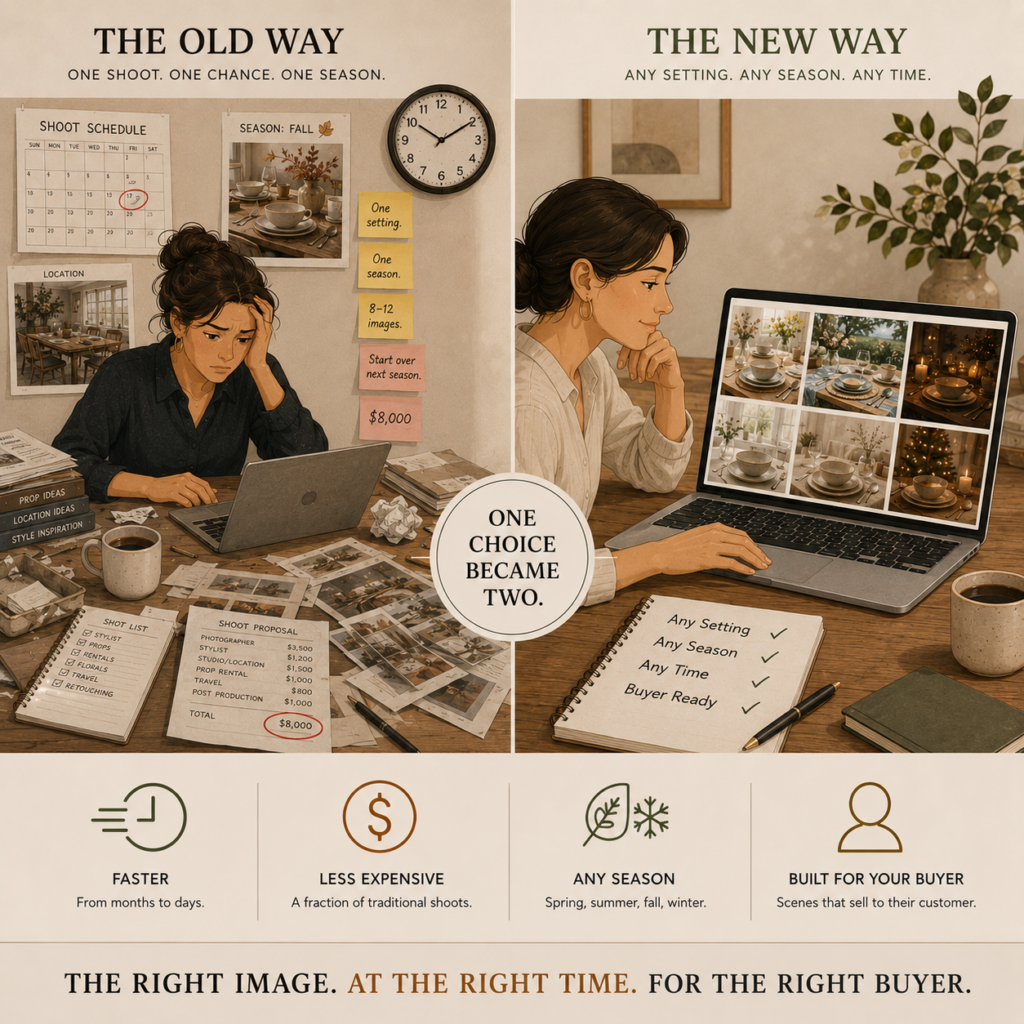
Until recently, if you needed professional lifestyle imagery, you had one option.
Book a shoot. Pay the day rate. Get one setting, one season, 8 to 12 images, and start planning the next shoot six months out.
That was the only choice.
Now there are two.
The Placement System at go483 delivers a complete lifestyle image suite — hero scene plus 5 to 7 close-up detail shots — every month, built around your product, your aesthetic, and your selling context.
Any setting. Any season. Any time of year.
At $750 a month for the Starter plan, it costs less than a half-day shoot. It delivers more images. It works on your buyer’s timeline, not a photographer’s availability calendar. And it fits your product to the scene — not the scene to whatever was available.
One is faster. One is less expensive. One can be any setting, in any season, whenever your buyer needs to see it.
The decision is yours. But now you have two options to make it with.
Learn how The Placement System works.
Go483 builds lifestyle image systems for wholesale home and tableware brands. Start with one product. Scale what works.